> For the complete documentation index, see [llms.txt](https://docs.aqua-cloud.io/documentation/llms.txt). Markdown versions of documentation pages are available by appending `.md` to page URLs; this page is available as [Markdown](https://docs.aqua-cloud.io/documentation/de-documentation/automatisierung/desktop-client/uft.md).
# UFT
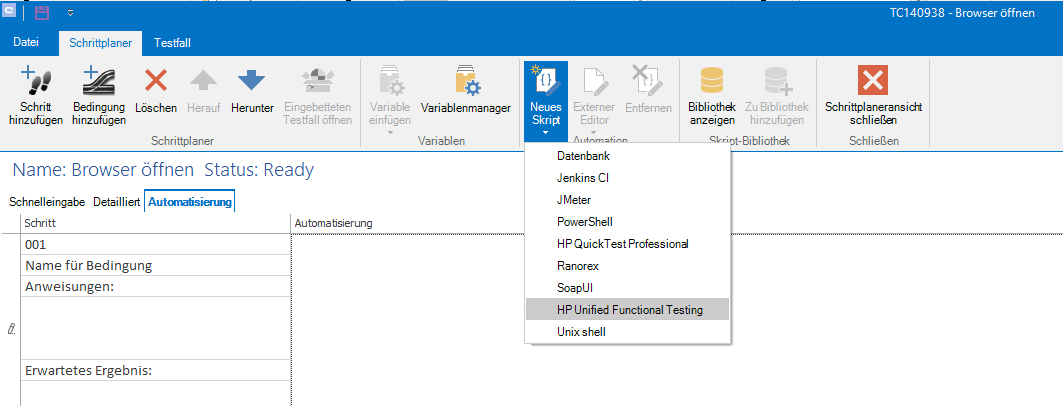
Zuerst öffnen Sie einen Testfall und klicken auf Automatisierung. Hier können Sie ein UFT Skript hinzufügen. Das Skript muss in UFT selbst erstellt werden. aqua erlaubt Ihnen den Import der UFT-Lösung, inklusive Datentabelle und Aktionen. Um die unterstützten Versionen zu sehen, schauen Sie sich die Systemanforderungen an.
Nachdem Sie das Skript hinzugefügt haben, haben Sie die Möglichkeit, Ihre existierende UFT Lösung zu importieren.
Um den Testfall auszuführen, müssen Sie den Agenten dementsprechend erstellen. Dann können Sie die Ausführung über den Button Ausführen starten. Die möglichen Agenten für die Ausführung werden über die Dropdown-Box ausgewählt. Die UFT Ergebnisse werden der Ausführung angehängt.\
### **Konfiguration des Agenten**
Entpacken Sie UFTAgent-\*.zip und öffnen aquaAgentUFTGui.exe.config.
Hier müssen Sie den Agenten Code und aquaServiceUrl setzen. \
Im Folgenden sehen Sie ein Beispiel:
```xml
```
---
# Agent Instructions
This documentation is published with GitBook. GitBook is the documentation platform designed so that both humans and AI agents can read, navigate, and reason over technical content effectively. Learn more at gitbook.com.
## Querying This Documentation
If you need additional information that is not directly available in this page, you can query the documentation by asking a question.
Perform an HTTP GET request on the following URL with the `ask` and `goal` query parameters:
```
GET https://docs.aqua-cloud.io/documentation/de-documentation/automatisierung/desktop-client/uft.md?ask=&goal=
```
`ask` is the immediate question: it should be specific, self-contained, and written in natural language.
`goal` is what the user is ultimately trying to achieve, the reason they need the answer. Sharing it helps GitBook give you a better, more relevant answer. A goal is most helpful when it describes the outcome the user wants rather than restating the question. For example, with `ask=how do I create an API token`, a goal like `automate deployments from our CI pipeline` lets GitBook tailor the answer to that use case.
The response will contain a direct answer to the question and relevant excerpts and sources from the documentation.
Use this mechanism when the answer is not explicitly present in the current page, you need clarification or additional context, or you want to retrieve related documentation sections.