> For the complete documentation index, see [llms.txt](https://docs.aqua-cloud.io/documentation/llms.txt). Markdown versions of documentation pages are available by appending `.md` to page URLs; this page is available as [Markdown](https://docs.aqua-cloud.io/documentation/items/test-cases-management/quick-run-test-execution-of-multiple-test-cases-at-once.md).
# Quick run: test execution of multiple test cases at once
Accelerate QA with aqua's Quick Run - execute multiple test cases at once, customize fields, and streamline defect detection for faster, more efficient software testing.
Quick run of test cases in aqua simplifies the testing process by enabling rapid feedback on software quality**.** This accelerated feedback loop expedites defect identification and resolution, streamlining the development cycle and ultimately delivering a superior end product. Moreover, Quick Run fosters more frequent testing, enabling early detection of issues that could otherwise fester into major problems later in the development process.
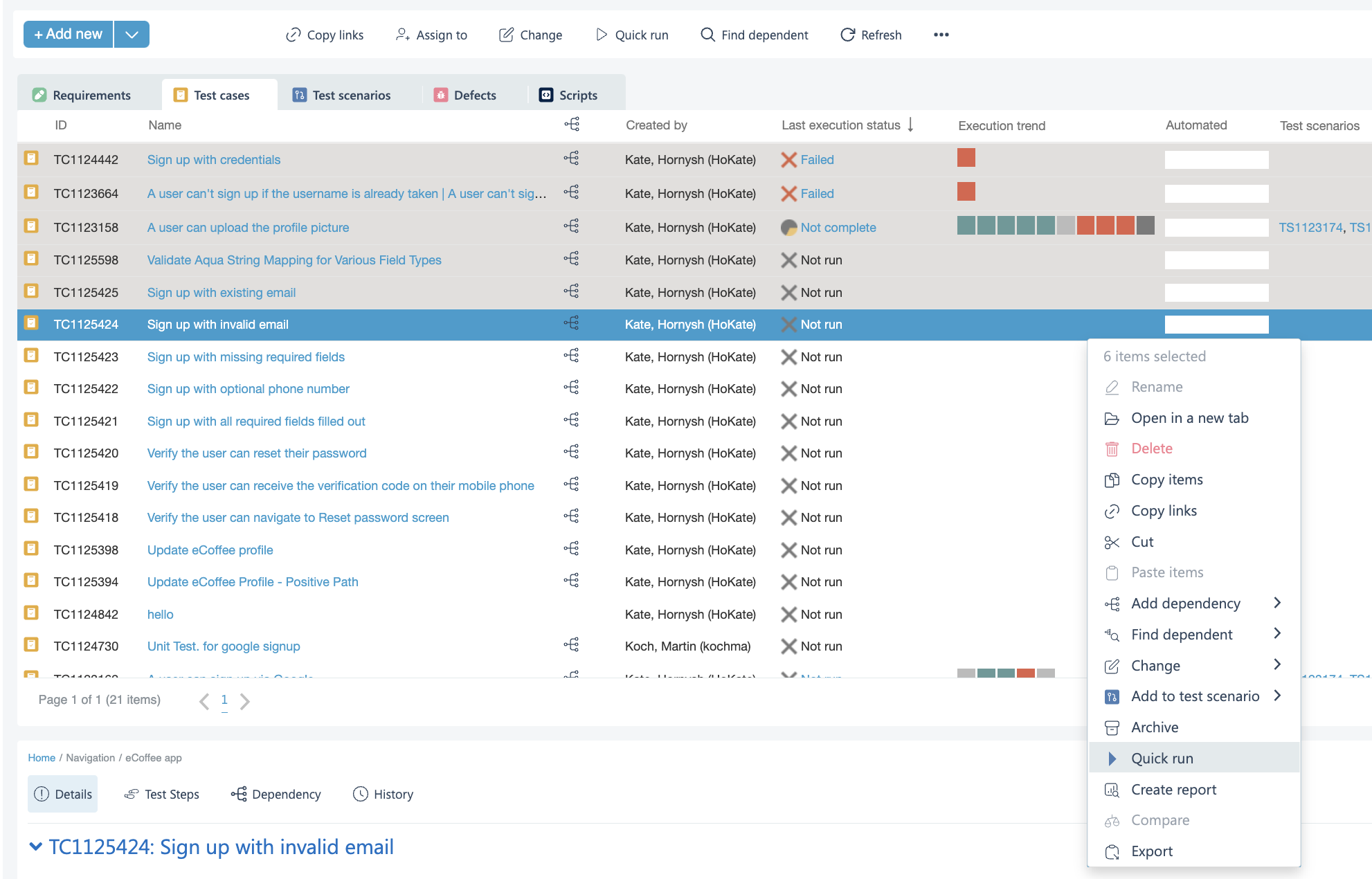
To quickly run a few test cases at once, first open 'Test case' tab at the navigation page.
Then select the test cases you want to execute, then righ-click and from the menu select 'Quick run'.
When modal appears, you will see the list of the selected test cases. Quickly review if you select the right ones.
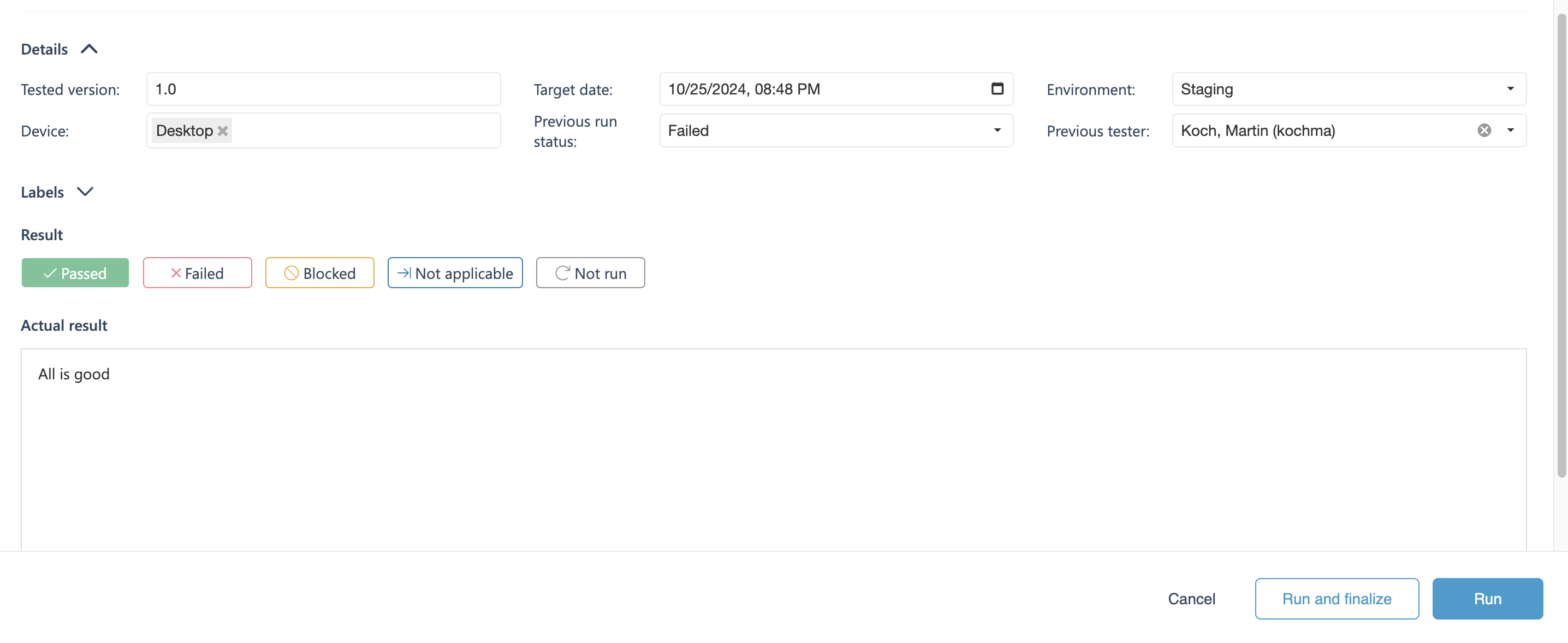
Select a value set for each test case if you want to parametrise them
Then select values for each field you added to your test case from the template page.
Add labels (optional).
Then define the status and provide a comment in the the actual result section.
Run the execution.
Optionally you can select 'Run and finalize'
{% hint style="info" %}
Please note that once you select 'Run and finalize', the runs can't be modified later.
{% endhint %}
When you run the test cases, the status and the actual result are applied to all steps of the test cases and executions. The results including details, status and actual results are saved in aqua as in general manual test execution and can be reviewed later under each test case.
**How to define custom fields for Quick run**
Select a project where you store your test cases and then click on the 'burger' menu icon.
Click on the 'Template' option
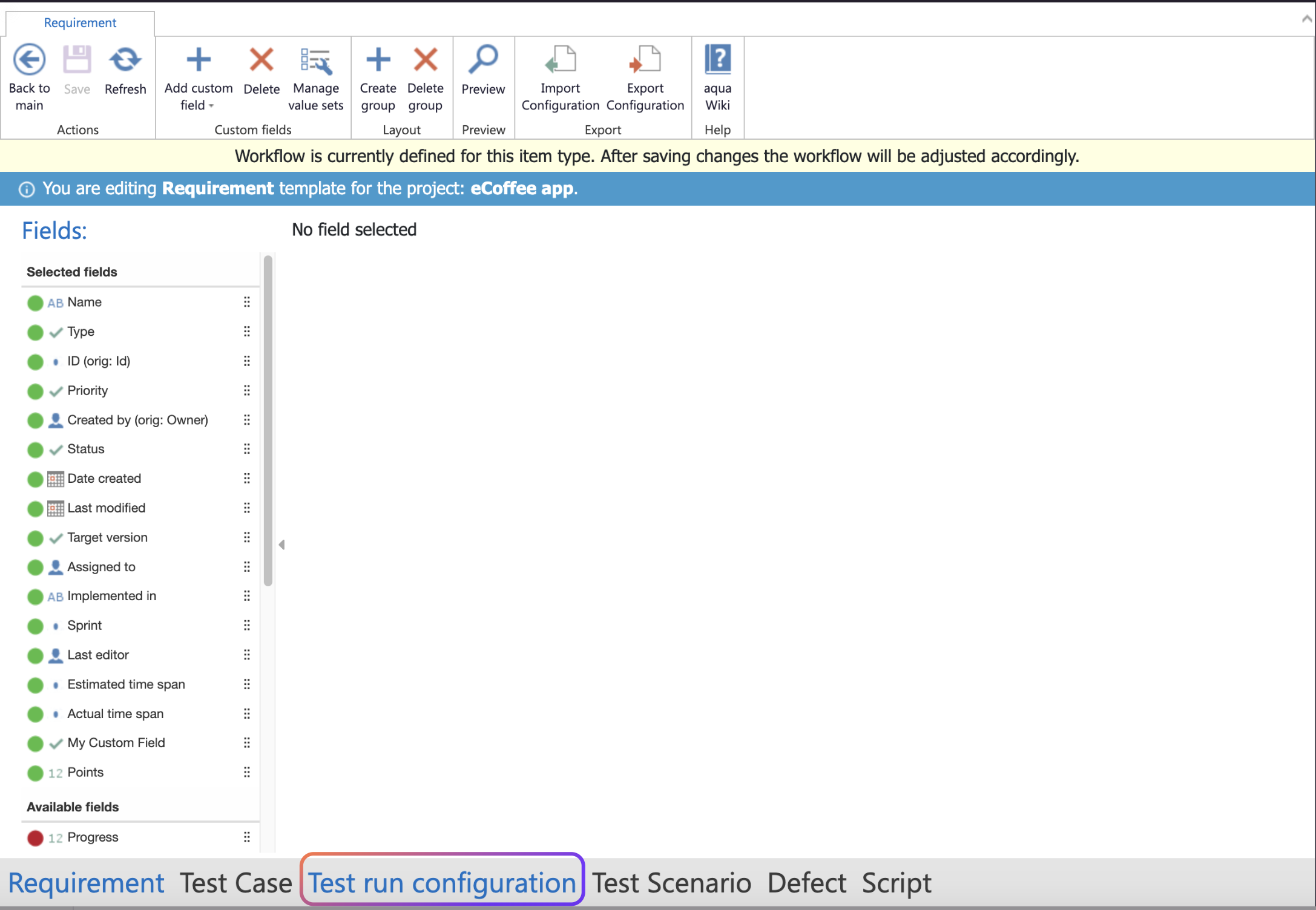
At the bottom select the 'Test run configuration' tab.
Then add any field and as many as you need.
Save the changes and navigate back to the project.
{% hint style="info" %}
Please note that once you define the fields, they are available either you:
* quickly execute test cases from navigation,
* run full manual test case or,
* execute it within a test scenario.
{% endhint %}
---
# Agent Instructions
This documentation is published with GitBook. GitBook is the documentation platform designed so that both humans and AI agents can read, navigate, and reason over technical content effectively. Learn more at gitbook.com.
## Querying This Documentation
If you need additional information that is not directly available in this page, you can query the documentation by asking a question.
Perform an HTTP GET request on the following URL with the `ask` and `goal` query parameters:
```
GET https://docs.aqua-cloud.io/documentation/items/test-cases-management/quick-run-test-execution-of-multiple-test-cases-at-once.md?ask=&goal=
```
`ask` is the immediate question: it should be specific, self-contained, and written in natural language.
`goal` is what the user is ultimately trying to achieve, the reason they need the answer. Sharing it helps GitBook give you a better, more relevant answer. A goal is most helpful when it describes the outcome the user wants rather than restating the question. For example, with `ask=how do I create an API token`, a goal like `automate deployments from our CI pipeline` lets GitBook tailor the answer to that use case.
The response will contain a direct answer to the question and relevant excerpts and sources from the documentation.
Use this mechanism when the answer is not explicitly present in the current page, you need clarification or additional context, or you want to retrieve related documentation sections.