> For the complete documentation index, see [llms.txt](https://docs.aqua-cloud.io/documentation/llms.txt). Markdown versions of documentation pages are available by appending `.md` to page URLs; this page is available as [Markdown](https://docs.aqua-cloud.io/documentation/projects-and-folders/project-wizard.md).
# Project wizard
Create independent or shared projects in aqua with the Project Wizard. Copy configurations, requirements, test cases, and defects for tailored or synchronized project setups.
In aqua, you can work with different projects at the same time. You can have different projects with different configurations, but you can also have different projects with shared configurations. You can create new projects and decide which configuration should be chosen to configure your individual project based on your specific needs.
### **Independent Projects**
Start the Project Wizard by clicking on the 'Add new' button and then select 'New project'.
Give it a unique name and click the 'Create' button.
**Using a source project for configuration**
If you don’t want to set up your project configuration from scratch, you can use an existing project as a source. This lets you inherit its settings, such as fields, workflows, and rules.
To do this:
1. Select a project from the **‘Source project’** drop-down.
2. Click **‘Create’**.
Your new project will now have the same configuration as the selected source project.
If you don’t choose a source project, your new project will be based on aqua’s default configuration.
### **Shared project configuration**
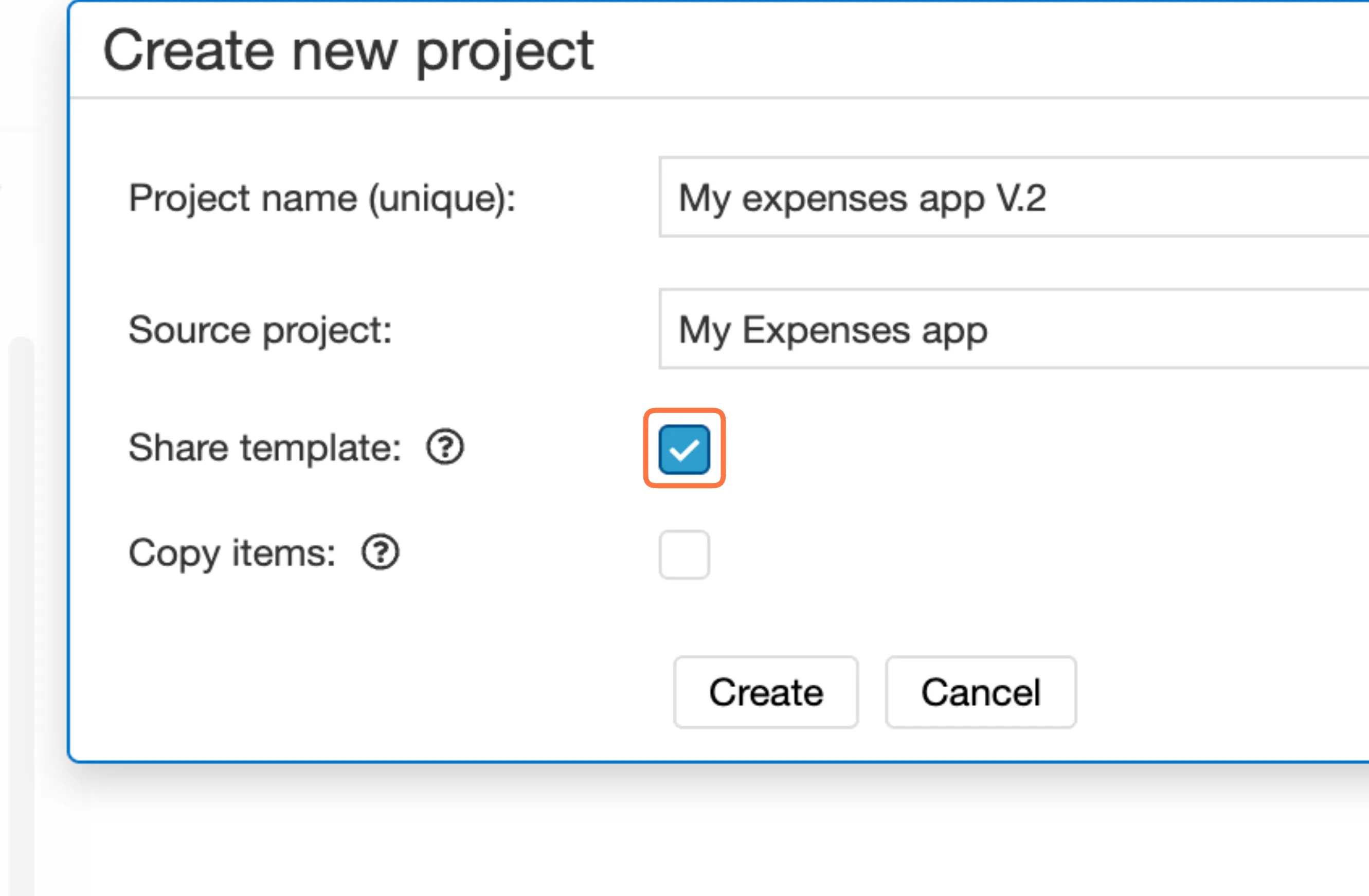
You can create a project that reuses the setup of another project, known as the *source project*. This is called a **shared project configuration**.
A shared project automatically inherits all configuration settings from the selected source (master) project. This includes:
* Default and custom fields (defined by the template)
* Workflow and advanced rules
* Field rules
Any updates made to the configuration in the source project are instantly applied to all linked projects. This helps ensure consistency across projects and saves time on setup.
To create a shared project, first select the source project and the check the **‘Share template’** option in the project creation wizard.
{% hint style="info" %}
**Please note:**\
You **cannot** modify the configurations directly in a shared project. All changes must be made in the source (master) project.
{% endhint %}
### Detach project configuration
If you realize that your project has grown beyond its original scope and needs a different setup, you can **detach** it from the master project. Detaching makes the project fully independent, allowing you to customize its configuration without affecting or being affected by the original master project.
{% hint style="info" %}
**Please note:**
Detaching is only available from the **Template configuration** page and **cannot be undone**. Once detached, the link to the master project is removed, and the configuration must be managed separately from that point on.
{% endhint %}
### **Copy items from an existing project**
If you select a source project, you can choose to copy its items into your new project. This includes:
* Requirements
* Test cases
* Test scenarios
* Defects
To do this:
1. Select a **Source project** from the drop-down.
2. Check the **Copy items** box.
3. Click **Create**.
Your new project will include all selected content from the source project. This is useful when you want to build on top of existing work instead of starting from scratch.
---
# Agent Instructions
This documentation is published with GitBook. GitBook is the documentation platform designed so that both humans and AI agents can read, navigate, and reason over technical content effectively. Learn more at gitbook.com.
## Querying This Documentation
If you need additional information that is not directly available in this page, you can query the documentation by asking a question.
Perform an HTTP GET request on the following URL with the `ask` and `goal` query parameters:
```
GET https://docs.aqua-cloud.io/documentation/projects-and-folders/project-wizard.md?ask=&goal=
```
`ask` is the immediate question: it should be specific, self-contained, and written in natural language.
`goal` is what the user is ultimately trying to achieve, the reason they need the answer. Sharing it helps GitBook give you a better, more relevant answer. A goal is most helpful when it describes the outcome the user wants rather than restating the question. For example, with `ask=how do I create an API token`, a goal like `automate deployments from our CI pipeline` lets GitBook tailor the answer to that use case.
The response will contain a direct answer to the question and relevant excerpts and sources from the documentation.
Use this mechanism when the answer is not explicitly present in the current page, you need clarification or additional context, or you want to retrieve related documentation sections.