> For the complete documentation index, see [llms.txt](https://docs.aqua-cloud.io/documentation/llms.txt). Markdown versions of documentation pages are available by appending `.md` to page URLs; this page is available as [Markdown](https://docs.aqua-cloud.io/documentation/reporting/pivot-table.md).
# Pivot table
Explore how to analyze and summarize complex data with the Pivot Table view in Reporting. Learn features, benefits, and tips for efficient data insights.
Pivot tables visualise multidimensional data.
* Columns and rows can be freely configured.
* Like diagrams, pivot tables are separately linked to the source data.
Pivot table view
* A Row area field configured on Status displays all the element's statuses as rows.
* The Column Area field, configured on Significance, displays all Significance value as columns.
* The Data Area field, configured on Number of Elements, displays the corresponding number of elements from the Status-Significance pairs.
### Example of how to create a pivot table:
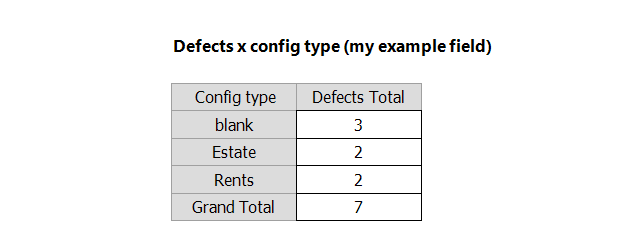
In order to count e.g. our defects accordingly to a certain argument or category (in other words a value field that was created for a defect), please follow the video:
{% embed url="" %}
{% hint style="info" %}
Make sure to unmark the field *Show data headers* in the Options -> View Options
See photo:
{% endhint %}
---
# Agent Instructions
This documentation is published with GitBook. GitBook is the documentation platform designed so that both humans and AI agents can read, navigate, and reason over technical content effectively. Learn more at gitbook.com.
## Querying This Documentation
If you need additional information that is not directly available in this page, you can query the documentation by asking a question.
Perform an HTTP GET request on the following URL with the `ask` and `goal` query parameters:
```
GET https://docs.aqua-cloud.io/documentation/reporting/pivot-table.md?ask=&goal=
```
`ask` is the immediate question: it should be specific, self-contained, and written in natural language.
`goal` is what the user is ultimately trying to achieve, the reason they need the answer. Sharing it helps GitBook give you a better, more relevant answer. A goal is most helpful when it describes the outcome the user wants rather than restating the question. For example, with `ask=how do I create an API token`, a goal like `automate deployments from our CI pipeline` lets GitBook tailor the answer to that use case.
The response will contain a direct answer to the question and relevant excerpts and sources from the documentation.
Use this mechanism when the answer is not explicitly present in the current page, you need clarification or additional context, or you want to retrieve related documentation sections.